

I. Introduction: The High-Stakes Hosting Decision
In 2026, hosting is no longer just about “keeping the lights on.” For a professional site with a 22-year legacy, your hosting provider is your primary partner in Core Web Vitals performance and cybersecurity. Building on our experience in digital scaling since 2004 , we have tracked how infrastructure dictates profit.
As a veteran agency, we have seen the industry consolidate into two elite choices: Kinsta and WP Engine. Choosing the wrong one can lead to “visit-count” bill shock or technical limitations that stall your growth. In this guide, we break down which provider truly delivers the best Return on Investment (ROI) for your digital assets.
II. Infrastructure: The 2026 Engine
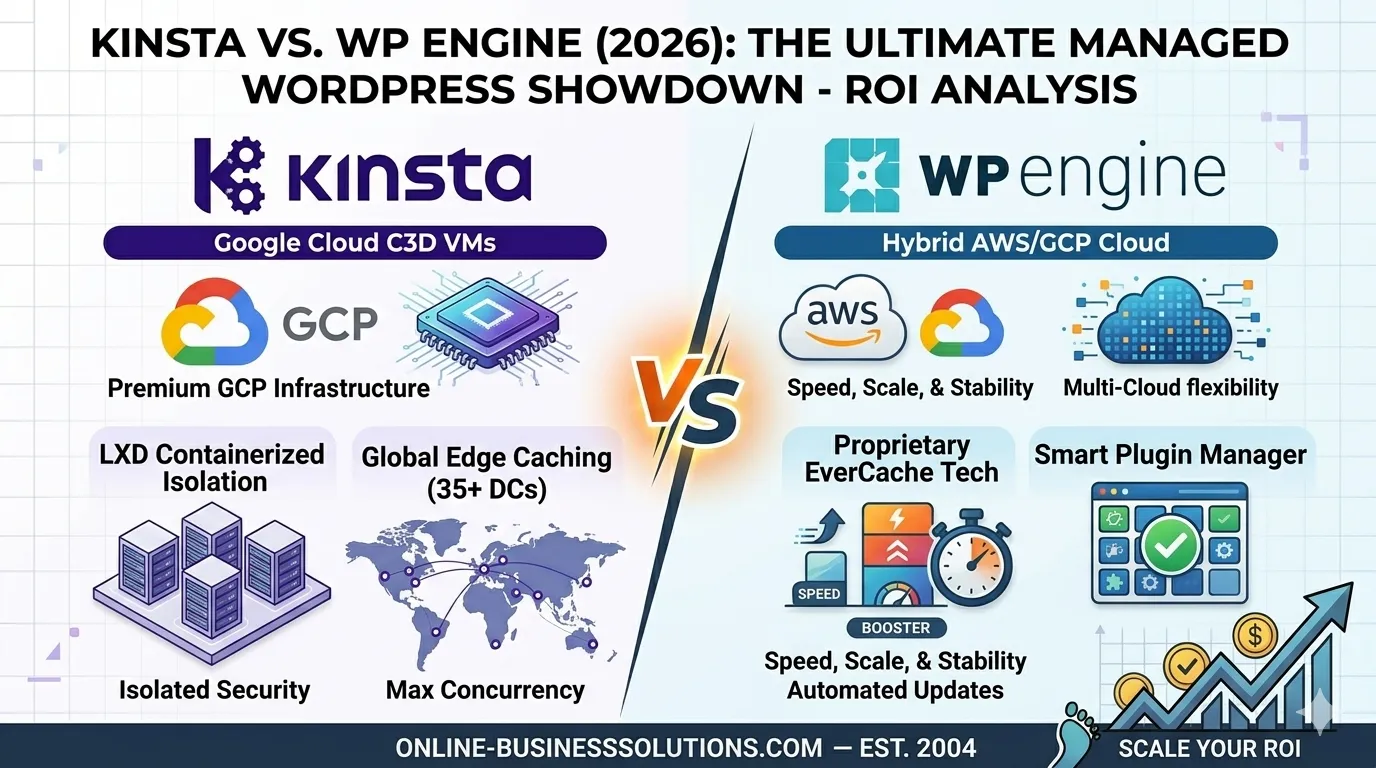
Kinsta: The Google Cloud Powerhouse
Kinsta has doubled down on its partnership with Google Cloud Platform (GCP). Utilizing their most advanced compute-optimized VMs, Kinsta ensures every site runs in an isolated LXD container. This means zero “noisy neighbor” issues—your resources are yours alone.
- 35+ Data Centers: Choose locations nearest to your audience.
- Cloudflare Edge Caching: Built-in integration provides 260+ edge locations for maximum speed.
- C3D Machines: Kinsta leverages the latest architecture for maximum processing speed.
WP Engine: The Enterprise Hybrid
WP Engine utilizes a hybrid cloud approach, leveraging both Google Cloud and AWS. Their proprietary EverCachetechnology is built specifically to handle massive WordPress traffic spikes.
- Smart Plugin Manager: Automatically updates and tests plugins using visual regression.
- Multi-Cloud Flexibility: Scalable infrastructure across different providers to ensure maximum uptime.
III. 2026 Performance Benchmarks: The Speed Test
In 2026, performance is defined by interactivity and visual stability. You can verify your current Time to First Byte (TTFB) using page sepeed tool.
- Uptime Monitoring: Kinsta monitors site uptime 480 times daily (every 2 minutes).
- Load Handling: Kinsta delivers load times between 500ms and 900ms, while WP Engine averages around 1.5 seconds for larger sites.
- Core Web Vitals: Both hosts are essential for passing Google’s assessment.
IV. 2026 Pricing Comparison: The “Visit” Trap
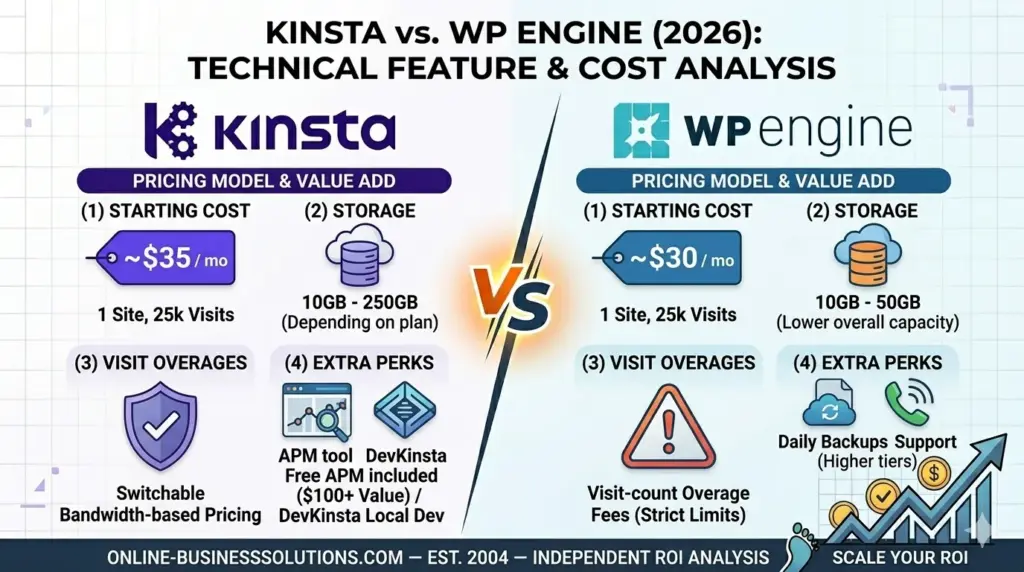
| Feature | Kinsta (2026) | WP Engine (2026) |
|---|---|---|
| Starting Price | ~$35/mo | ~$30/mo |
| Visit Limit | 35,000 | 25,000 |
| Pricing Model | Visit OR Bandwidth-based | Visit-based |
| Money-Back | 30 Days | 60 Days |
Export to Sheets
The Kinsta Advantage: Kinsta filters bot and AI crawler traffic from visit counts, ensuring you only pay for legitimate human traffic. For those running heavy digital stores, as analyzed in our [Link to: Shopify vs. Custom Development Article], hosting costs can make or break your margins.
V. Security and Reliability
Security in 2026 requires more than just a simple firewall.
- Enterprise Protection: Both platforms are fully compliant with security standards for enterprise data protection.
- Malware Services: Kinsta offers a free malware removal service, while WP Engine includes proactive threat detection.
- Backups: Both provide daily backups, but Kinsta offers paid hourly backup add-ons for mission-critical data. WP Engine provides a 60-day money-back guarantee, giving you a long window to test these protocols.
VI. Developer and Agency Tools
- Agency Features: WP Engine provides white-label portals and client billing handoff systems.
- Developer Access: Kinsta includes free Application Performance Monitoring (APM) on all plans to pinpoint slow plugins or database queries.
VII. The ROI Verdict: Which Host Wins?
- Choose Kinsta if: You prioritize a modern dashboard (MyKinsta), specialized Google Cloud performance, and want built-in APM tools.
- Choose WP Engine if: You need phone support, require agency tools for client management, or want a longer test window.