

I. Introduction: The Agentic Shift in 2026
In 2026, the definition of “business automation” has shifted from simple data-syncing to Agentic Workflows. With the rise of autonomous AI agents, the tool you choose to act as the “brain” of your operations is the most critical decision in your tech stack.
At Online Business Solutions, we have tracked the evolution of no-code tools since 2004. We’ve seen the rise of simple “If This, Then That” logic transform into complex, multi-dimensional neural networks of apps. Zapier vs. Make in 2026 remaining the two titans today. While both can connect your CRM to your email, the way they handle your data—and your budget—is worlds apart.
II. The Philosophical Divide: Ease vs. Architecture
Zapier: The “Interface-First” Ecosystem
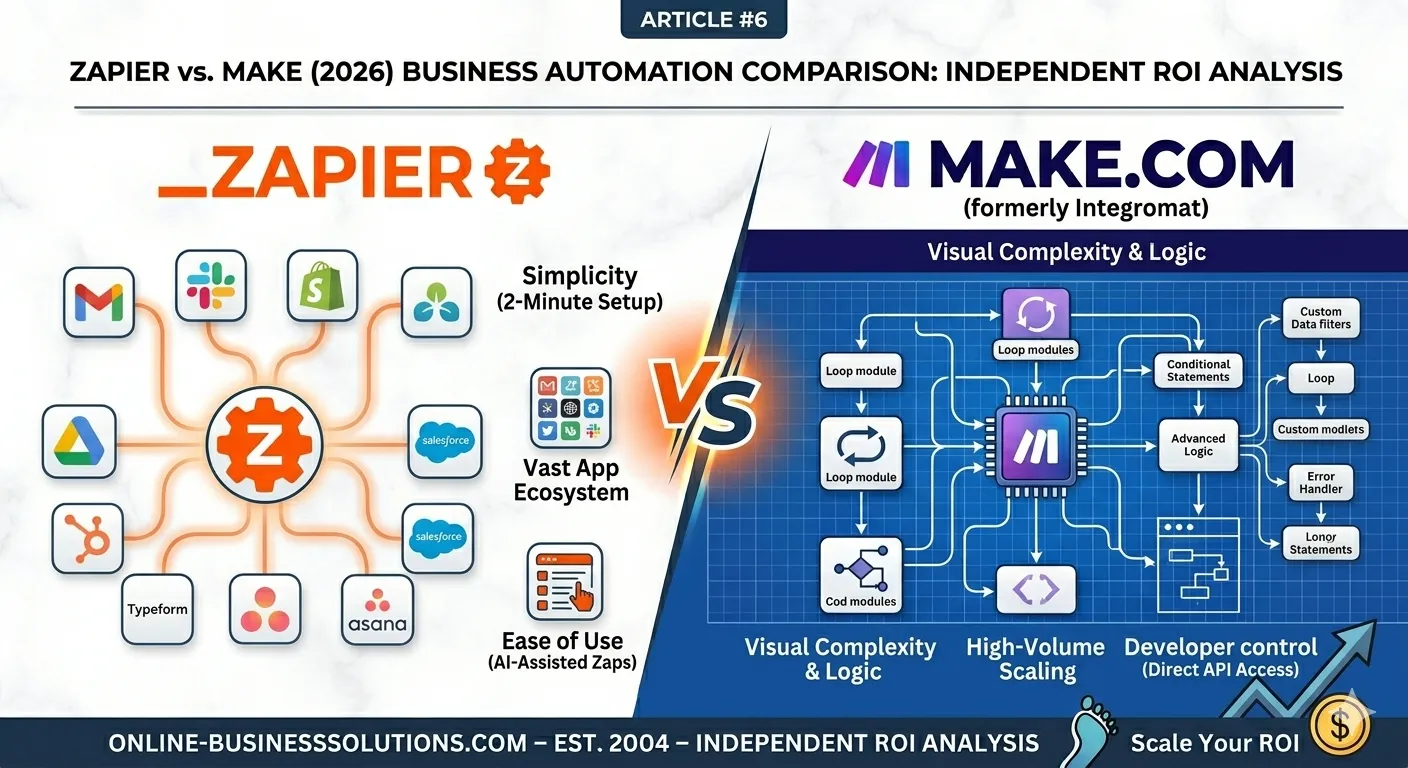
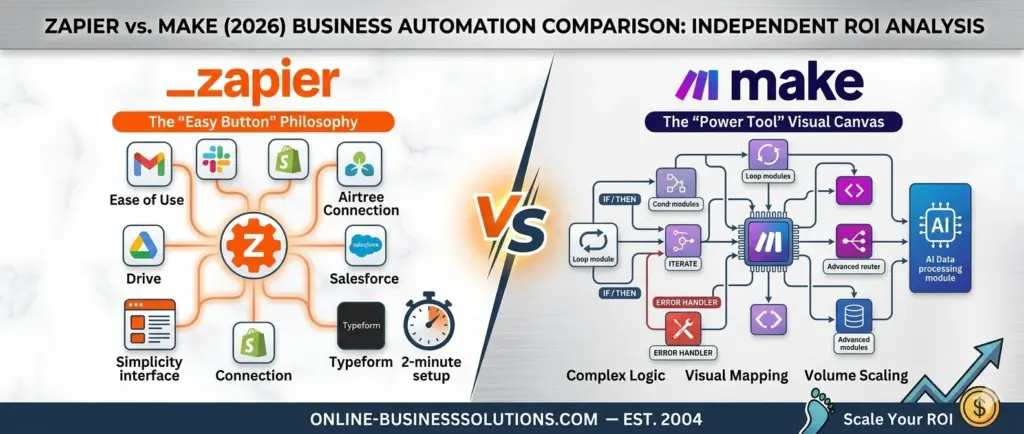
Zapier’s goal has always been democratization. Their 2026 update, Zapier Central, allows users to teach AI agents how to behave across 7,000+ apps using natural language.
- The Hook: If you can describe a task in English, you can automate it.
- The Reality: You pay a premium for this “magic” interface. Zapier is built for the CEO who wants things done now, not the developer who wants to see the plumbing.
Make: The “Visual Logic” Powerhouse
Make (formerly Integromat) treats your business like a circuit board. Instead of a linear list of steps, you get a visual canvas where you can drag, drop, and branch data paths in 360 degrees.
- The Hook: Infinite flexibility and a pricing model that rewards scale.
- The Reality: The learning curve is real. You don’t “describe” a workflow in Make; you engineer it.
III. Detailed Feature Comparison
1. Integration Breadth (The 7,000+ App Elephant)
Zapier remains the undisputed king of connectivity. If you are using a niche real estate CRM or a new 2026 AI startup tool, Zapier likely has the integration.
- Zapier: 7,000+ apps.
- Make: 1,800+ apps.
- The Verdict: While Make has the “big hitters” (Shopify, Google, Slack), Zapier is the only choice if your workflow depends on obscure, industry-specific software.
2. AI & Autonomous Agents
In 2026, both platforms have integrated LLMs (Large Language Models), but their execution differs:
- Zapier AI: Focuses on “Zaps that think.” It can summarize a lead’s intent before sending it to your Slack. Its Canvas tool helps you map out AI-human hybrid workflows.
- Make AI: Focuses on data transformation. It excels at taking massive amounts of raw data, passing it through an AI module for sentiment analysis or translation, and routing it based on the output.
IV. The “Wallet Test”: 2026 Pricing Deep-Dive
This is where most business owners make a mistake. Zapier and Make count your “work” differently.
Zapier’s “Task” Model
A “Task” is an action your Zap successfully performs.
- Example: If you have a 5-step Zap that runs 1,000 times a month, that is 1,000 tasks.
- The Cost: Zapier’s “Professional” plans can quickly climb to $400 – $600/month once you pass the 10,000 task mark.
Make’s “Operation” Model
An “Operation” is counted every time a module in your scenario is triggered.
- Example: That same 5-step workflow in Make would count as 5 operations per run. 1,000 runs = 5,000 operations.
- The Cost: While the number of operations sounds higher, Make’s per-unit cost is significantly lower. You can often run a high-volume business on Make for $30/month that would cost $300/month on Zapier.
V. Performance & Reliability: Under the Hood
For a business with a 22-year legacy like ours, we value Error Handling.
- Zapier: Offers “Autoreplay.” If an app goes down, Zapier waits and tries again later. Simple, effective, hands-off.
- Make: Offers “Error Handler Routes.” You can actually build a specific path for what happens if a step fails (e.g., If Shopify fails to update, send an SMS to the manager and log it in Google Sheets). This is professional-grade resilience.
VI. Use Case Scenarios: Zapier vs. Make in 2026, Which is for You?
Scenario A: The Solo-Founder / Marketer
You need to connect an Instagram ad to a Lead Magnet and a CRM. You have 2 hours a week for tech.
- Recommendation: Zapier. The time you save on setup is worth the higher monthly fee.
Scenario B: The Scaling E-commerce Brand
You are processing 500 orders a day. You need to sync inventory across 3 platforms, calculate custom shipping taxes, and send personalized AI-written thank-you notes.
- Recommendation: Make. The complex logic and volume-based pricing will save you thousands of dollars a year in overhead.
VII. The ROI Verdict: 20-Year Veteran Perspective
After two decades of observing software cycles, our conclusion for 2026 is clear:
- Buy Zapier for Speed. It is an investment in your agility.
- Build on Make for Scale. It is an investment in your infrastructure.
Most high-growth businesses eventually use both: Zapier for the “quick and dirty” marketing connections and Make for the heavy-duty data processing that powers their core product.
VIII. FAQ: Common Automation Questions
- Is Make harder to learn than Zapier? Yes, expect to spend 5–10 hours mastering the interface compared to 30 minutes on Zapier.
- Can I migrate from Zapier to Make? There is no “one-click” button, but in 2026, many AI tools can help you map your Zap logic into a Make Scenario.
- Which is more secure? Both are SOC2 compliant and offer enterprise-grade encryption.